
REVIEW · WALKING TOURS
Prague Art Nouveau and Cubism Walking Tour
Prague’s façades tell two stories on one walk. This small-group, historian-led route lets you spot gingko-leaf Art Nouveau details, then pivot to Cubist angles in places like the House of the Black Madonna. I like how the guide connects design to Czech history and even the practical building tech behind it, and I like that the pace is thoughtful enough for questions. The one drawback: you’ll be walking for about three hours, so plan comfy shoes and a rain layer.
You get to choose the morning or afternoon departure, and you finish in a central area where it’s easy to keep exploring on your own. With up to 8 people, the experience feels more like a guided conversation than a photo line. Expect English commentary, a mobile ticket, and stops where free admission is part of the plan.
In This Review
- Key points before you go
- Starting at Ovocný trh, then walking the clues
- Art Nouveau details you will catch fast, from motifs to typography
- Cubism shows up as sharp angles, and you’ll be ready for it
- Obecní dům and the tech story hiding in plain sight
- K+K Hotel Central and Café Imperial, when Art Nouveau turns into interior design
- Cubist symbolism at Czechoslovak Legion Bank
- Prague Main Train Station and why the dome deserves your time
- Wenceslas Square to Lucerna Music Bar, the style sweep across the city
- The upside-down statue, King Wenceslas, and the National Revival theme
- Price and logistics, and whether it is worth $126.71
- Who this tour suits best (and who should skip it)
- Guides you might meet, and the value of asking questions
- Should you book this Prague Art Nouveau and Cubism walk?
- FAQ
- How long is the Prague Art Nouveau and Cubism walking tour?
- Is the tour offered in English?
- What group size should I expect?
- Are any entrance fees included?
- What is included in the price?
- Where do I meet and where does the tour end?
Key points before you go
- Small group max 8, so you can ask questions and get answers that actually fit your interests.
- Art Nouveau to Cubism contrast, with clear visual cues you’ll learn to spot on your own later.
- Landmarks with free admission time, including major interiors like the Czech capital’s famous buildings.
- Historian guide focus, tying architecture to the politics and wars that shaped modern Prague.
- Route pacing that can adjust, sometimes with a quick tram hop if the group is strong walkers.
Further routes we laced boots for
- Prague: 3-Hour Walking Tour of Old Town & Prague Castle★ 4.7 · 5,696 reviews
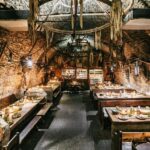
- Prague: Ghost Walking Tour Where Legends Come To Life★ 4.4 · 5,253 reviews
- Prague: Jewish Quarter Walking Tour with Admission Tickets★ 4.7 · 3,729 reviews
- Prague Guided Walking Tour and Cruise with Authentic Czech Lunch★ 5.0 · 3,627 reviews
Starting at Ovocný trh, then walking the clues
Most tours begin at Ovocný trh 19 in Staré Město, and they end at Café Louvre on Národní 22. That matters because you’re starting in the older core and finishing near a classic Prague hangout, right where you can grab a meal or continue sightseeing without scrambling for transit.
This is built for people who want context, not just snapshots. The group size (up to 8) helps a lot, because the guide can steer you toward the details that make Art Nouveau and Cubism look so different, even when you’re standing on a busy street. It’s also one of those walks where you get more from slowing down. You’ll notice things at close range, like lettering style, façade ornament, and the way forms either curve softly or break into sharp geometry.
You’ll also want to plan for weather. Prague can be wet and gray, and there’s no magic way around being outdoors, but the mix of public spaces and interior stops helps. If rain shows up, you’ll still have enough built-in stops to keep the tour moving and interesting.
Art Nouveau details you will catch fast, from motifs to typography
The Art Nouveau portion is where you start training your eyes. The guide points out signature façade cues, including gingko leaves that show up on elegant exteriors. You’ll also learn how Eastern art and aesthetics influenced the movement, which is a key idea if you’ve ever wondered why some Prague ornament feels both delicate and bold at the same time.
One thing I love about this kind of architectural walk is that it gives you a checklist. Here, the checklist is visual: elaborate light fixtures, curvy lettering, and ornamental flourishes that make buildings feel almost animated rather than purely functional. When you understand the influences, the style stops being a vague label and becomes a readable language.
You’ll see this energy in places that feel classic and central, but the guide keeps it specific. You’re not just standing in front of a pretty façade, you’re learning what designers were trying to communicate, especially when cities were modernizing fast. Art Nouveau in Prague wasn’t only about decoration, it was also about optimism, modern tastes, and a new way to design the everyday.
Cubism shows up as sharp angles, and you’ll be ready for it
Then the route turns, and Cubism becomes the counterpoint. Prague is one of Europe’s major centers for Cubist art, and the tour makes sure you don’t miss it. You’ll look for crystal-like forms and geometric thinking that shows up in buildings, not just in paintings.
The House of the Black Madonna is the first major Cubist stop. Even if you’re not a hardcore architecture person, this is the kind of place where you immediately feel the difference. Art Nouveau often wraps the building in curves and ornament. Cubism breaks the surface into planes and shapes, so the whole façade seems to reorganize itself as you move around it.
What’s especially useful is how the guide explains the contrast. Instead of treating styles like museum labels, you learn why they became appealing in different moments. That framing helps you connect architecture to bigger shifts in culture, identity, and the changing mood of Europe at the time.

Obecní dům and the tech story hiding in plain sight
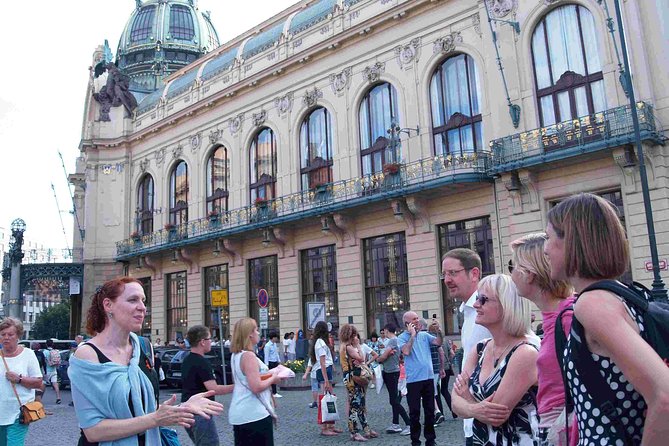
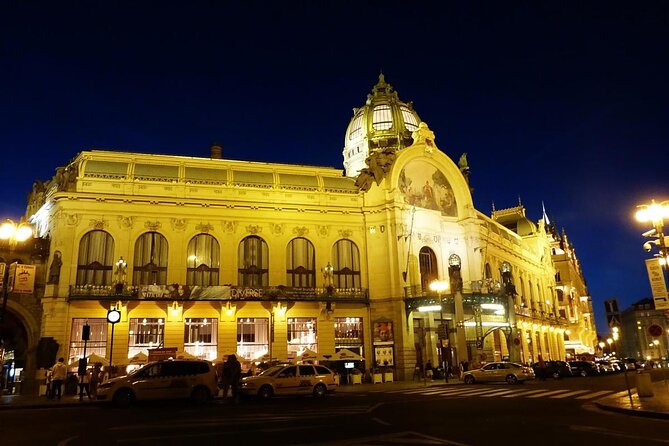
Obecní dům is one of Prague’s iconic Art Nouveau landmarks, and it’s a great spot to slow down. The exterior is memorable, but the real value comes from what the guide adds: how advanced building ideas were showing up around the turn of the century.
You’ll hear about construction technologies that sound almost futuristic, like central heating and ventilation, drinking water systems, hydraulic elevators, steam-powered laundry, and even an intercom system. The point isn’t to memorize everything. The point is to understand that these buildings weren’t only aesthetic statements. They were also engineering showcases.
This is one of the moments where the historian approach pays off. Architecture becomes more than style. You start seeing it as infrastructure for daily life, for comfort, for efficiency, and for the confidence of people living through modernization.
K+K Hotel Central and Café Imperial, when Art Nouveau turns into interior design
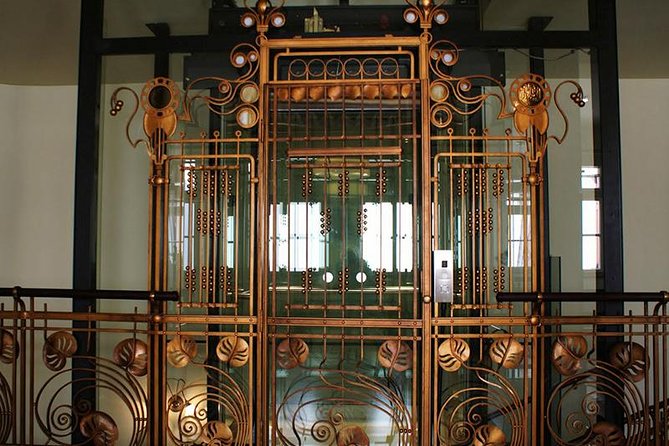
K+K Hotel Central is described as the first Art Nouveau building in Prague, and that gives the stop extra weight. You’re not just viewing ornament, you’re seeing early proof of a new design language taking hold. The tour keeps your attention on the visual signals that mark Art Nouveau, so when you pass similar buildings later, you’ll recognize the style faster.
Then you move into the mood of Café Imperial, where you get a look at a distinctive Art Nouveau interior. This is a smart pairing because Prague’s exterior façades can be easier to spot from a distance. Interior design is where the movement gets personal, and you can see how the same principles work on a smaller scale: in decorative details, layout, and the sense of elegance meant for everyday public life.
Just remember: food and drinks are not included unless something is specified. If you want to linger with a coffee or a sweet treat, do it, but treat it as extra. For planning, it’s good to treat Café Imperial like a visual stop first, and a break second.
Cubist symbolism at Czechoslovak Legion Bank
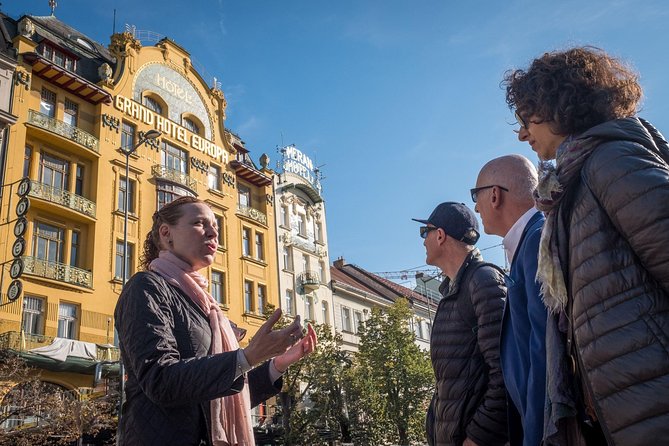
Next comes Czechoslovak Legion Bank, notable for both its Cubist architecture and its interior dedicated to the Czechoslovak Legion connected to the First World War. This stop works because it shows how architecture can carry political meaning without being loud about it.
Cubism is often discussed as an art style, but here you see it in civic architecture. That link between design and national stories makes the style feel less abstract. It also helps you understand why Prague’s architectural timeline can feel like chapters, not just eras of taste.
If you like history that connects to real places, this is one of the stops that sticks. You’ll likely leave with a better sense of why symbolism matters in public spaces, especially in Central Europe where the 20th century brought huge changes.
Prague Main Train Station and why the dome deserves your time
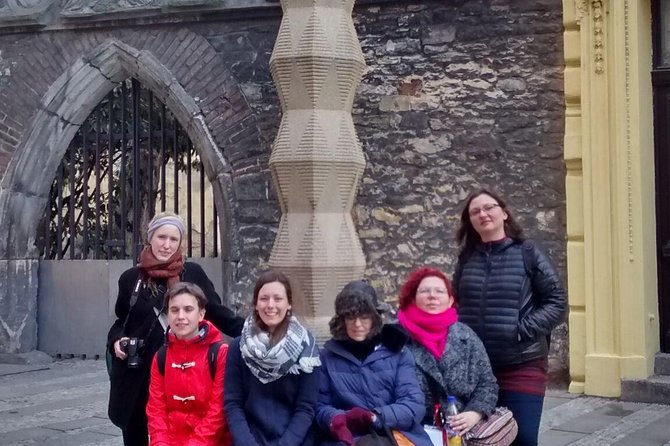
Prague Main Train Station is famous for its Art Nouveau interior, including a dramatic dome. This is one of those stops where most people walk past quickly, especially if they are only thinking about transit.
Here, you get the chance to look up, slow down, and appreciate the station as architecture with identity. The dome gives you scale, and the details give you craft. It’s also a useful way to understand Art Nouveau’s goal: to bring beauty into functional spaces, not only into private homes or fancy museums.
This also ties into a practical travel moment. The guide can point out how to navigate within the station area. That kind of help can save you time later when you’re catching trains or transferring. Even if you don’t have a connection scheduled immediately, it helps you feel less lost in one of Prague’s busiest interiors.
Wenceslas Square to Lucerna Music Bar, the style sweep across the city
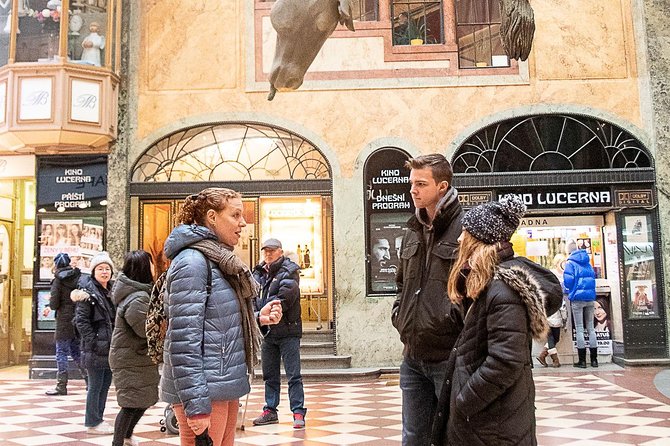
Wenceslas Square is next, and it’s where the tour becomes a city-wide style reading. The guide discusses Art Nouveau and Art Deco architecture around the square, which helps you place Prague’s design evolution in a broader timeline rather than treating Art Nouveau and Cubism as isolated islands.
From there, you head toward Lucerna Music Bar, known for its Art Nouveau interior and for the most beautiful arcades of Prague. This stop is a great contrast to the station, because you’re shifting from a major public transit interior to an entertainment and social space. The design feels more intimate even when it’s still grand.
The tour also connects Lucerna to turn-of-the-century Czech optimism and avant-garde movements. Then it makes sure you don’t skip the darker side of the story, by explaining how fierce European wars changed Prague’s course. That history backdrop keeps the architecture from feeling like a separate category from real life.
The upside-down statue, King Wenceslas, and the National Revival theme
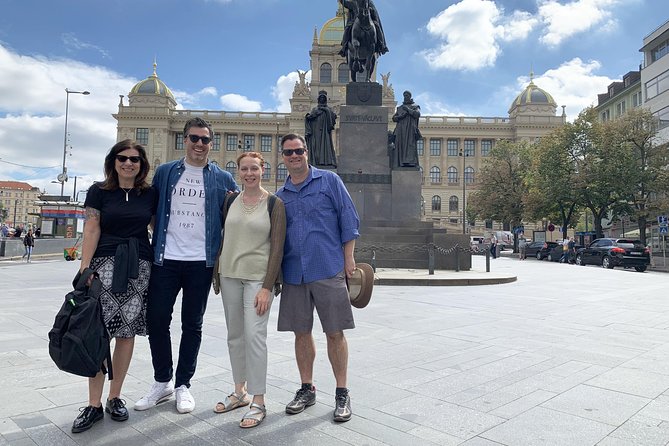
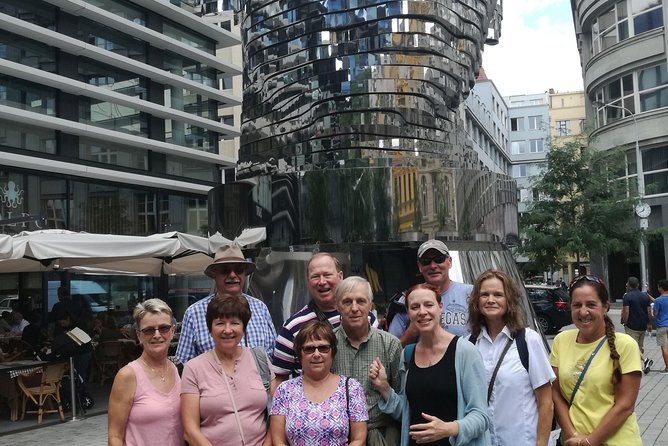
The walk ends with a stop at the upside-down statue of King Wenceslas riding a dead horse. This is a powerful last moment because it takes you from architecture into symbolism and national storytelling.
The guide explains the connection to Czech history and the Czech National Revival. Even if you don’t know much about the topic, you’ll understand the idea: monuments do not just commemorate, they also challenge, criticize, and reflect changing values. In a tour about design movements, this stop is a reminder that art and architecture keep evolving after the styles of a specific era fade.
It’s also an ideal ending because the tour finishes close to Café Louvre, which is right in the middle of the action. Café Louvre opened in 1902, and it’s the kind of place where historical atmosphere still feels present. Franz Kafka, Albert Einstein, and T. G. Masaryk are linked to its earlier fame, which makes it a fitting place to close a tour about Prague’s artistic momentum.
Price and logistics, and whether it is worth $126.71
At $126.71 per person for about three hours, this is not a budget-only walk. But it prices in a few things that matter: a historian guide, a small-group cap of 8, and multiple stops where free admission is part of the plan.
I see this as good value if you want interpretation, not just entry tickets. The architecture in Prague can be impressive, but without context it can also blur together. Here, you get help learning the visual cues that separate Art Nouveau curves from Cubist angles, and you get those cues connected to history and changing ideas.
It’s also bookable with a bit of planning. This tour is typically booked around 69 days in advance, which is a sign that it sells out on popular dates. If you’re traveling in peak season, book earlier rather than gambling on a last-minute spot.
If you’re tight on time, three hours is a sweet spot. It’s long enough to cover major sights and still explain what to look for. It’s short enough that you can layer it with a museum visit or a longer evening out afterward.
Who this tour suits best (and who should skip it)
This is a strong fit if you like architecture, design details, and a clear explanation of styles. You’ll also enjoy it if you’re the kind of traveler who likes to understand why a place looks the way it does, not just that it looks good.
It also suits groups with mixed interests because the guide ties the buildings to broader storylines: technology, civic life, wars, and cultural shifts. In one family-style review, people reported ages ranging from 19 to 76 all enjoying it, which is a useful sign that the pacing and storytelling can work across generations.
Consider a skip if you hate walking or if you only want high-speed sightseeing with minimal conversation. This walk is built around attention. It asks you to look closely, and if you prefer a stop-and-go format, you might find it slower than you want.
Guides you might meet, and the value of asking questions
One thing that really shows up in the guide experience is engagement. Names that came up include Vadim, Betty, Matous, Bonita, and Vitam. Across those accounts, the common thread is that the guide uses real enthusiasm for the subject and encourages questions.
That matters because architecture is full of details that you cannot guess from a brochure. When a guide responds directly, you start building a framework for your future self-guided wandering. You won’t just see buildings, you’ll learn how to interpret them.
On some days, the guide may tailor the route to what your group cares about. In at least one case, that even included a tram ride to reach a farther area for exploration. If you walk well and want more coverage, you can likely ask the guide about options.
Should you book this Prague Art Nouveau and Cubism walk?
Book it if you want a guided architecture lesson that actually changes how you see Prague. The combination of Art Nouveau motifs like gingko leaves and curvy lettering, then the sharp turn into Cubism, makes the city feel like a living design story. Add historian context about technology and historical upheaval, and the stops make more sense as you go.
Skip it only if you want a quick checklist of attractions with minimal explanation. This tour rewards curiosity. If you’re willing to slow down, ask questions, and look at façades like they are readable text, you’ll get real value out of the time and the price.
FAQ
How long is the Prague Art Nouveau and Cubism walking tour?
It lasts about 3 hours.
Is the tour offered in English?
Yes, the tour is offered in English.
What group size should I expect?
The tour has a maximum of 8 travelers.
Are any entrance fees included?
The tour includes stops where admission tickets are listed as free.
What is included in the price?
A historian guide is included.
Where do I meet and where does the tour end?
You start at Ovocný trh 19, Staré Město, and the tour ends at Café Louvre on Národní 22.
Prague on Laced Boots




More Tours in Prague

More Tour Reviews in Prague

Freshly written up in Prague
- World War II 4WD Tour from Prague with Lunch
★ 4.4 · 3 reviews - World War II History Tour of Prague’s Old Town
★ 5.0 · 3 reviews - Welcome to Prague – Private Tour with Licensed Guide
★ 5.0 · 3 reviews - Gourmet Brunch with Chef: Unlimited Drinks & Stunning River Views
★ 5.0 · 3 reviews - VIP Prague Segway Tour Around Monastic Breweries
★ 4.0 · 3 reviews
Walking Tours, compared.
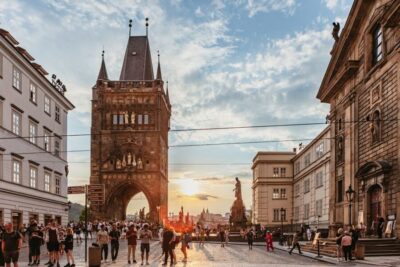
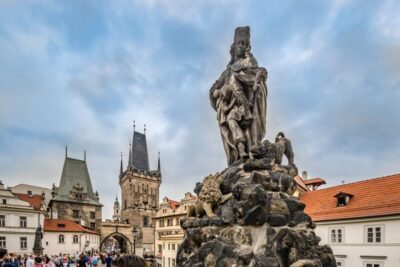 ★ 4.73-Hour Walking Tour of Old Town & Prague CastleFrom $305,696 reviews
 ★ 4.4Ghost Walking Tour Where Legends Come To LifeFrom $275,253 reviews
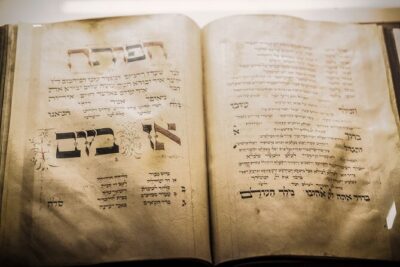 ★ 4.7Jewish Quarter Walking Tour with Admission TicketsFrom $763,729 reviews
 ★ 5.0Prague Guided Walking Tour and Cruise with Authentic Czech LunchFrom $1023,627 reviews
 ★ 4.6Old Town and Jewish Quarter Guided Walking TourFrom $222,847 reviews
 ★ 4.5Prague Ghost and Legend of Old Town Walking TourFrom $212,630 reviews
 ★ 5.0Prague 3-hour Afternoon Walking Tour including Prague CastleFrom $531,899 reviews
 ★ 4.7Ghosts and Legends Nighttime Guided Walking TourFrom $221,462 reviews
Browse the lists this tour appears in