
REVIEW · PRAGUE CASTLE TOURS
Prague Castle St. Vitus Cathedral, Royal Palace, St. George’s Basilica
Prague Castle tells stories if you listen. This 3-hour German tour, led by historian Robert Procházka, strings together St. Vitus Cathedral, the old Royal Palace, St. George’s Basilica, and Golden Lane in a way that makes the whole site feel coherent, not like four random stops.
I especially like the strong, grounded storytelling, and the way the history is tied to what you can actually see right in front of you, including major royal and religious sites.
I also love how the architecture spans Gothic, Renaissance, and Baroque influences, so you notice how Prague changed over centuries instead of treating everything as one style. One drawback to plan around: entrances to the cathedral and palaces are not included in the tour price, so you’ll pay extra for tickets (with the guide’s help).
In This Review
- Key things to know before you go
- Meeting at Pražský hrad and how the 3-hour rhythm works
- St. Vitus Cathedral: coronations, saints, and the Wenceslas Chapel climb
- Old Royal Palace: crown jewels, the throne room, and the politics spark
- St. George’s Basilica: a 10th-century tomb with a grim story
- Golden Lane: Rudolf II’s alchemists, the search for gold, and Kafka’s Prague
- Prague Castle grounds and the city views that make it worth walking
- Price and ticket strategy: what $41 really buys
- Practical tips for a German tour inside Prague Castle
- Should you book this Prague Castle historian tour?
- FAQ
- How long is the Prague Castle tour?
- What language is the guided tour in?
- Where is the meeting point?
- Which places does the tour visit?
- Is the entrance ticket included in the tour price?
- How much are the entrance tickets?
- How do I buy the entrance tickets?
- Is the tour suitable for children?
- What is the cancellation policy?
Key things to know before you go
- A historian-led route that connects buildings to real events, not just facts on a sign
- St. Vitus Cathedral highlights like the Wenceslas Chapel and the spiral staircase up to the crown chamber
- Royal Palace must-sees including a replica of the Bohemian crown jewels and the large late Gothic throne room
- Golden Lane culture from Emperor Rudolf II’s alchemists to Franz Kafka’s connection
- Time-efficient sightseeing for a big UNESCO-scale complex in about 3 hours
Other routes onto the Castle promontory, compared
- Prague Castle 2.5-Hour Tour Including Admission Ticket★ 4.7 · 8,927 reviews
- Prague: 3-Hour Walking Tour of Old Town & Prague Castle★ 4.7 · 5,696 reviews
- Prague: 3-Hour Old Town and Prague Castle Tour in German★ 4.8 · 5,671 reviews
- Prague: Prague Castle and Lobkowicz Palace Entry Tickets★ 4.4 · 5,066 reviews
Meeting at Pražský hrad and how the 3-hour rhythm works
The tour meets directly at the streetcar stop Pražský hrad. Use streetcar lines 22 or 23 in the direction of Bílá hora, then get off at Pražský hrad and meet at the stop. Your guide is Robert Procházka.
The whole experience is built for a very practical pace. You’ll move through interiors and key spaces inside Prague Castle, then finish at Golden Lane. The activity schedule also lists returning back to the meeting point area, so plan to be flexible about exactly how the final stretch looks depending on where you stop for the wrap-up.
Because it’s a German-language tour, it helps if you can follow spoken German at least at a basic level. If you cannot, you might still enjoy the visuals, but you will lose a lot of the payoff that comes from the historian’s explanations.
St. Vitus Cathedral: coronations, saints, and the Wenceslas Chapel climb
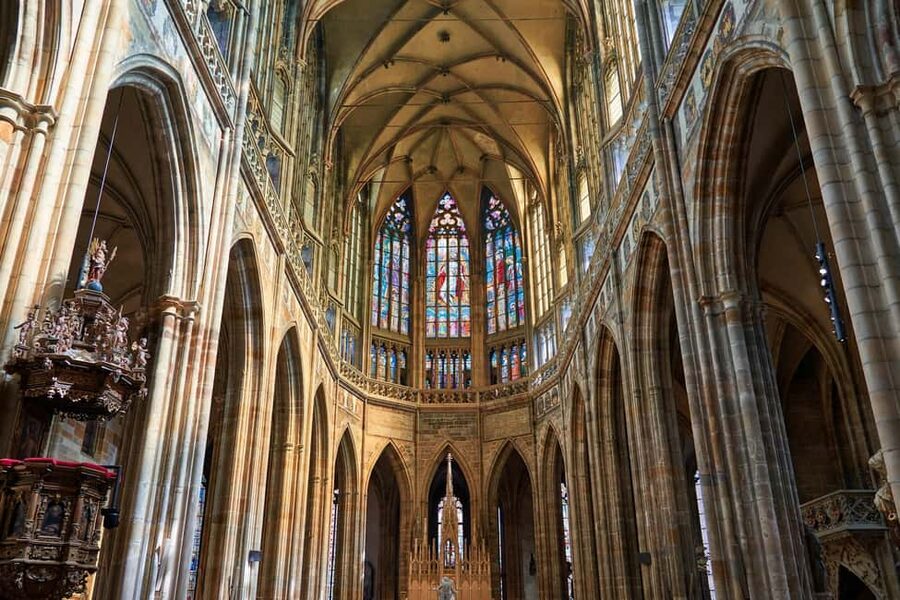
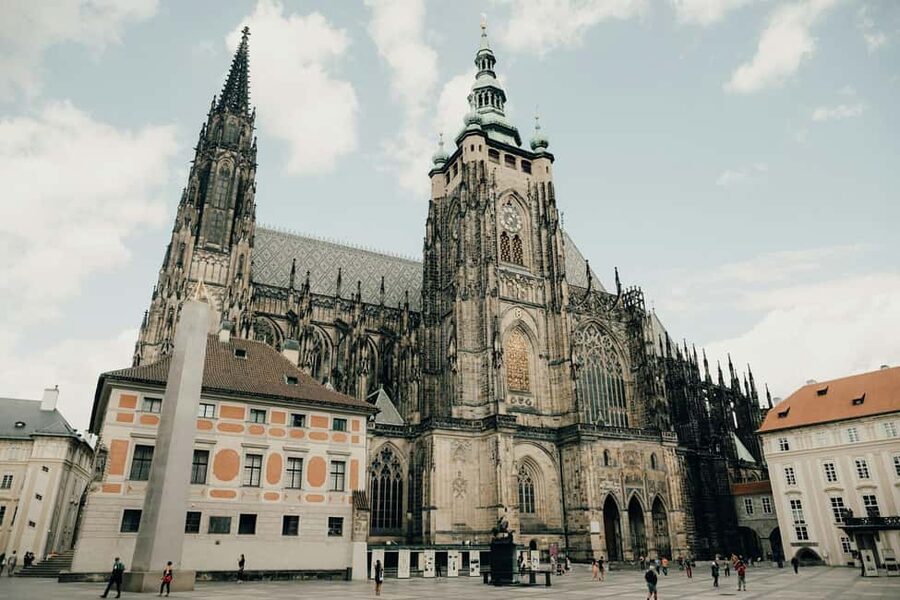
St. Vitus Cathedral is the emotional center of this castle complex, and it makes sense that the tour starts with it. This is the burial and coronation site of Bohemian kings. Even if you’re not a royal history person, the building makes it easy to understand why rulers cared so much about this place.
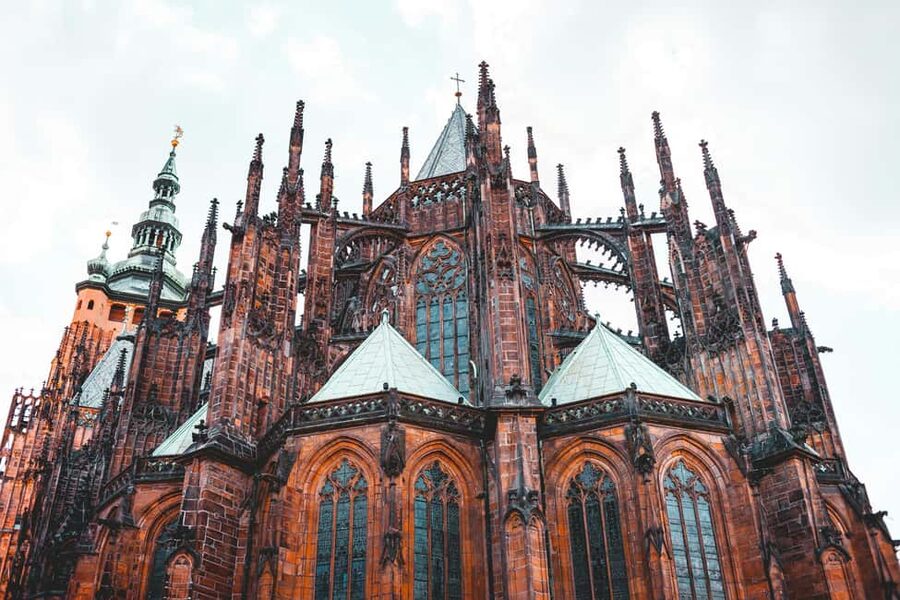
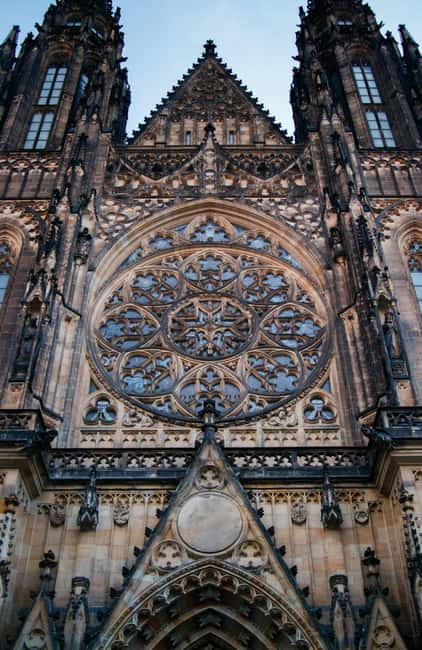
What I like most is how the cathedral story stretches across time. The oldest predecessor building, a Romanesque rotunda, dates to around 925. Then, as centuries rolled on, the cathedral became a masterpiece of 14th century Gothic architecture. That mix matters because Prague didn’t build one “forever” church. It kept adding chapters.
You’ll also hear about major patron saints of the Czech lands buried here, including St. Wenceslas and St. Adalbert. It helps to see the tombs and shrines as part of the same message: legitimacy through faith, and faith made visible through stone.
One of the most specific, memorable parts is the route connected to Wenceslas. The Wenceslas Chapel is decorated with semi-precious stones, and the remains of St. Wenceslas are kept in a Gothic shrine. From there, a spiral staircase leads up toward the crown chamber, where the coronation regalia are kept. The tour’s structure is useful here because it guides your eyes, so you understand what each space is for.
Old Royal Palace: crown jewels, the throne room, and the politics spark
The Old Royal Palace is where the story gets louder. This isn’t only a religious site. It’s a stage for power, ceremonies, and events that changed Europe.
Inside, you can see a replica of the Bohemian crown jewels. That replica detail is worth your attention because it turns the abstract idea of coronation regalia into something you can connect to the cathedral theme you just saw. You’re basically stepping from the spiritual “why” into the political “how.”
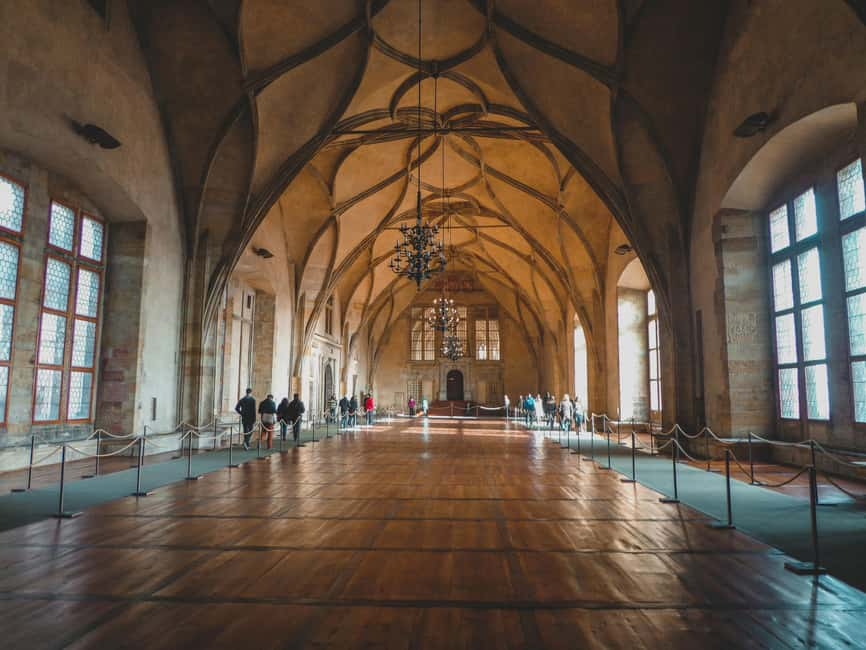
The Royal Palace also includes the largest late Gothic throne room in Central Europe. Even without special knowledge, you can feel what that size is trying to communicate. Thrones and public spaces were made for showing authority, not for quiet reflection.
Then there’s the moment that feels almost cinematic: the site of the Third Defenestration of Prague, connected to the State Chancellery. This is tied to the start of the Thirty Years’ War. That’s big history, but the value here is that you’re not reading it from a book. You’re standing in the place where that escalation is remembered.
The practical takeaway for you: this stop turns the architecture into a political map. You’ll likely walk away understanding why rooms, corridors, and entrances mattered in conflicts, not just in paintings.
St. George’s Basilica: a 10th-century tomb with a grim story
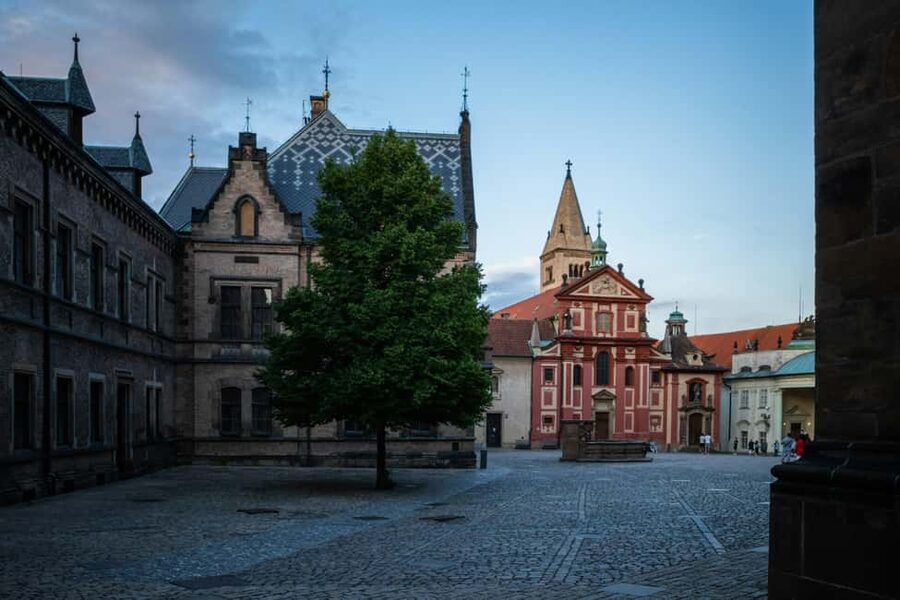
St. George’s Basilica is a different tone from the cathedral. It goes back to the 10th century and feels more anchored to the earlier foundations of Prague’s Christian world.
Here, the key point is the tomb of St. Ludmila. She is the grandmother of St. Wenceslas. Her story is also dark: she was strangled to death by Viking warriors on behalf of her daughter-in-law. The historian’s explanation helps you connect that brutality to the power struggles of the period rather than treating it as a random tragedy.
If you like when tours bring personal names into big timelines, this is one of the stops that delivers. It’s not only about rulers and wars. It’s also about family lines, alliances, and how religion and politics got entangled.
Golden Lane: Rudolf II’s alchemists, the search for gold, and Kafka’s Prague
Golden Lane is the kind of place you walk through and suddenly understand why visitors love Prague Castle. It’s picturesque, compact, and strongly tied to daily life in the castle.
This lane takes you back to the 16th century. Emperor Rudolf II’s alchemists lived and worked here, searching for an elixir of life and trying to produce gold from lead. That’s not a small detail. It’s a window into how seriously educated people pursued wild ideas when science and magic had a lot more overlap than we pretend today.
What you can remember easily is how the lane turns abstract ambitions into physical space. Tiny houses and narrow lanes create a sense of intensity. You feel how cramped life would have been for anyone trying to work through long experiments.
Golden Lane also connects to literature. Franz Kafka lived in one of the little houses here. If you enjoy tracing famous people to real locations, this detail adds a layer that feels personal and modern after the older royal and religious themes.
The tour ends in Golden Lane, which I think is a smart choice. You finish with a place that’s visually easy to absorb, so even if you’re starting to feel castle-fatigued, you still end on something memorable.
Prague Castle grounds and the city views that make it worth walking
You don’t just tour interiors. You also get time on the castle grounds, and the view is a major reason people come to Prague Castle in the first place.
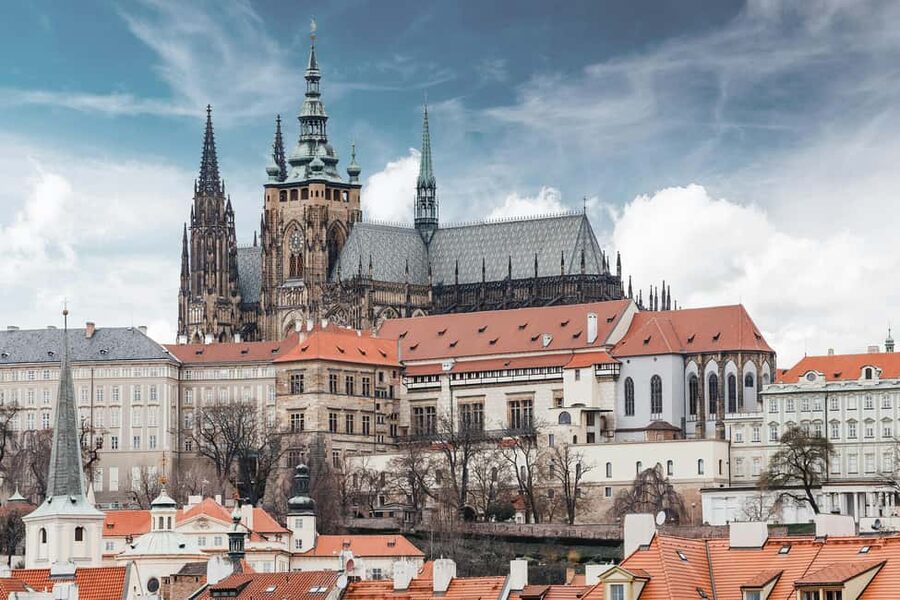
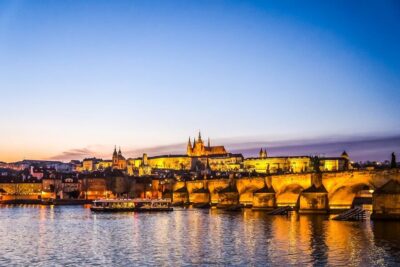
The grounds are listed in the Guinness Book as the largest enclosed castle grounds in the world. That matters because it explains what you feel when you’re there. It’s not one building. It’s a whole environment, and your walking path is part of the experience.
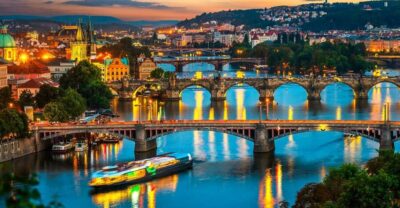
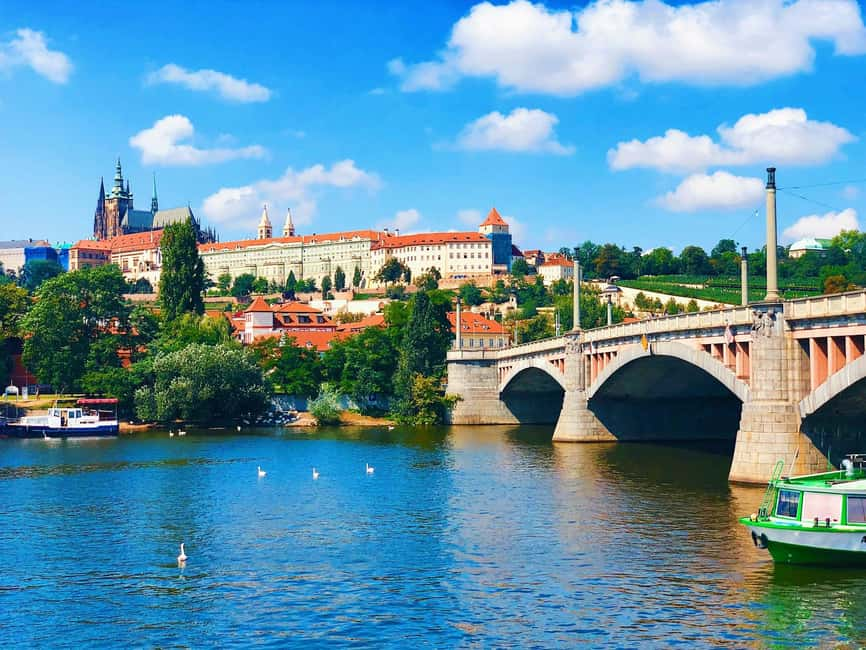
The tour highlights that you can enjoy a magnificent view of the whole of Prague from the castle grounds. That viewpoint is best treated as a payoff moment. After you’ve seen cathedrals, palaces, and basilicas, standing above the city makes the stories feel larger than the stones you were just inside.
If you’re trying to get great photos, plan on giving yourself a little time to pause. A historian may be talking while you’re walking, but for the view you’ll want your own moment. Prague is made for that.
Price and ticket strategy: what $41 really buys
The tour price is $41 per person for a 3-hour guided experience in German by a historian through the castle grounds and the interiors of the historic buildings.
Important: entrance tickets are not included. You’ll pay separately at the castle ticket office. The provided ticket amounts are 18 EUR for adults and 14 EUR for seniors (from 65 years of age). The guide will accompany you to the ticket office, where you can pay with a payment card. You can also hand over the amount in EUR directly to the guide, who will obtain the ticket for you.
So is it good value? For me, it reads as solid value if you care about context. You’re paying for a guided path that covers multiple high-impact interiors in one run: St. Vitus Cathedral, the Old Royal Palace, St. George’s Basilica, and Golden Lane. Without a guide, you would still see the sights, but you’d have to piece together why certain spaces matter, like the Wenceslas Chapel to crown chamber connection, or why the defenestration event is tied to the Thirty Years’ War.
The main tradeoff is you still need to budget time and money for entrance tickets. The good news is the tickets are purchased at a counter exclusively for guides, and the guide will purchase them together with you, so you are not stuck in the longest public queue.
Practical tips for a German tour inside Prague Castle
Because this tour is in German, your best move is to set expectations. If you speak German comfortably, you’ll probably get the full value of the historian storytelling. If you don’t, you can still enjoy the architecture, but you might want to bring a bit of patience and be ready to rely on visible details more than spoken explanations.
Here are a few practical habits that will help:
- Arrive a touch early at the Pražský hrad streetcar stop so you’re not rushing into the first cathedral moment.
- Wear shoes that handle uneven castle ground. You are moving through a large enclosed complex.
- Bring a light layer if you run warm inside churches but feel cooler outdoors near viewpoints.
- Keep your camera ready for Golden Lane. The narrow feel and bright details make it easy to get good shots without chasing angles forever.
The itinerary includes some physically interesting spaces, like the spiral staircase tied to the Wenceslas Chapel and the crown chamber concept. You will want to treat stairs carefully and take your time.
Also, note the tour is not suitable for children under 10. That’s not about being unkind. It’s a practical call for a complex, walking-focused historic site with interiors.
Should you book this Prague Castle historian tour?
I’d book this tour if you want a structured, 3-hour way to understand Prague Castle instead of wandering room to room. The promise here is strong: St. Vitus Cathedral, the Royal Palace including the throne room and defenestration connection, St. George’s Basilica with St. Ludmila’s tomb, and Golden Lane with Rudolf II’s alchemists and Kafka. That mix is exactly what makes Prague Castle feel like a whole story.
You should skip it or look for another option if German is a problem for you, because the tour is explicitly in German. Also, factor in the extra entrance tickets for each site, even though the guide helps you handle them efficiently.
If your goal is value plus context, this hits a nice sweet spot: major sites, a historian-led narrative, and end-with-a-view pacing that keeps the experience from dragging.
FAQ
How long is the Prague Castle tour?
The tour lasts 3 hours.
What language is the guided tour in?
The live guided tour is in German.
Where is the meeting point?
The meeting point is directly at the streetcar stop Pražský hrad (Prague Castle). Use streetcar line 22 or 23 in the direction of Bílá hora.
Which places does the tour visit?
You visit St. Vitus Cathedral, the Old Royal Palace, St. George’s Basilica, and the Golden Lane.
Is the entrance ticket included in the tour price?
No. Entrance tickets for St. Vitus Cathedral, the Old Royal Palace, St. George’s Basilica, and the Golden Lane are not included.
How much are the entrance tickets?
Adults pay 18 EUR. Seniors from 65 years of age pay 14 EUR.
How do I buy the entrance tickets?
The guide accompanies you to the castle ticket office. You can pay with a payment card, or you can hand the amount in EUR to the guide, who will obtain the tickets for you.
Is the tour suitable for children?
No. It is not suitable for children under 10 years.
What is the cancellation policy?
Free cancellation is available up to 24 hours in advance for a full refund.
More Tour Reviews in Prague


The Castle Promontory, Revisited

Freshly written up in Prague
- World War II 4WD Tour from Prague with Lunch
★ 4.4 · 3 reviews - World War II History Tour of Prague’s Old Town
★ 5.0 · 3 reviews - Welcome to Prague – Private Tour with Licensed Guide
★ 5.0 · 3 reviews - Gourmet Brunch with Chef: Unlimited Drinks & Stunning River Views
★ 5.0 · 3 reviews - VIP Prague Segway Tour Around Monastic Breweries
★ 4.0 · 3 reviews
Prague Castle Tours, compared.
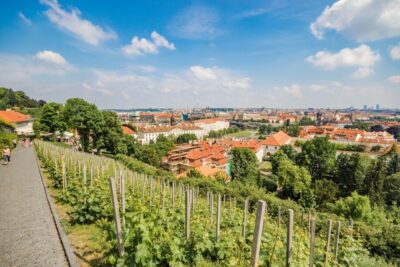 ★ 4.7Prague Castle 2.5-Hour Tour Including Admission TicketFrom $578,927 reviews
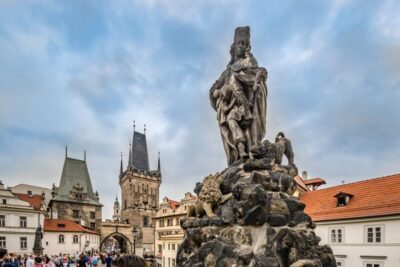 ★ 4.73-Hour Walking Tour of Old Town & Prague CastleFrom $305,696 reviews
 ★ 4.83-Hour Old Town and Prague Castle Tour in GermanFrom $365,671 reviews
 ★ 4.4Prague Castle and Lobkowicz Palace Entry TicketsFrom $385,066 reviews
 ★ 5.0Prague 3-hour Afternoon Walking Tour including Prague CastleFrom $531,899 reviews
 ★ 4.5Prague Castle Tour Including Admission Ticket – 2.5 HourFrom $591,171 reviews
 ★ 4.6Prague Castle: Midday Classical Concert at Lobkowicz PalaceFrom $281,106 reviews
 ★ 4.0Full-Day Prague Tour with Prague Castle, Lunch and Vltava CruiseFrom $75921 reviews
Browse the lists this tour appears in