
REVIEW · COMMUNIST PRAGUE & COLD WAR HISTORY
Private Prague Cold War Walking Tour
Prague can feel like a postcard, until you walk where power pressed down. This private Cold War walking tour turns a few city blocks into a real timeline, from Soviet-era control to the 1989 Velvet Revolution. I love that you get undivided attention from a historian guide as you move between landmarks tied to everyday life under communism. One heads-up: Vitkov Hill has a steep climb, so it may not feel great for everyone.
What I like most is how the tour connects the buildings to human choices. You see symbolic sites like the Red Army Hall and the former mausoleum of Klement Gottwald, then you shift into street-level protest culture with the John Lennon Wall and the Wenceslas Square demonstrations.
The only downside I’d plan around is logistics around admission. The tour includes tram tickets, but some key monuments at Vitkov Hill are not included, so you should expect to pay at least for that stop if you want to go inside.
In This Review
- Key highlights worth planning for
- Entering Cold War Prague: what this tour actually teaches
- Start point and timing: how to make the 3 hours feel easy
- Stop 1: the Karlin-Zhizhkov pedestrian tunnel and why “sealed doors” matter
- Vitkov Hill: the Red Army Hall, Gottwald’s mausoleum, and the pay-off views
- The Red Army Hall and Soviet memory politics
- Klement Gottwald’s mausoleum, plus the eerie details
- Jan Žižka monument and a city that spreads out
- Prague TV tower (Žižkov): brutalism with a strong opinion
- Wenceslas Square: where 1968 was crushed, then 1989 exploded
- Lennon Wall: protest graffiti as a Cold War conversation
- The upside-down King Wenceslas statue, and why Prague loves irony
- Tram tickets included, admission not included: how to budget the “real” cost
- Who should book this Cold War Prague walking tour
- Mobility note: Vitkov Hill is the one thing to plan around
- Should you book this tour?
- FAQ
- How long is the Private Prague Cold War Walking Tour?
- Is this a private tour?
- What language is the tour offered in?
- What is included in the price, and is admission covered?
- Do I need to arrange pickup, or is there a meeting point?
- Can I cancel for a full refund?
Key highlights worth planning for
- Private historian guide with a calm, Q and A style pace, not a rushed group march
- Vitkov Hill views plus the Red Army Hall and the Gottwald mausoleum site
- Karlin-Zhizhkov pedestrian tunnel with locked doors to Cold War nuclear shelter corridors
- John Lennon Wall protest graffiti, placed in the context of Cold War pressure
- Wenceslas Square as the stage for Warsaw Pact tanks in 1968 and the Velvet Revolution in 1989
Walking the 1948 to 1989 chapters of Prague
- Prague: Communism History and Nuclear Bunker Guided Tour★ 4.7 · 2,417 reviews
- Communism & Nuclear Bunker Tour + 70s Canteen Lunch (own expense)★ 5.0 · 1,036 reviews
- Prague: Communism and Bunker Tour with 70s Canteen Lunch★ 4.8 · 250 reviews
- Prague: World War II and Communist History Tour★ 4.7 · 130 reviews
Entering Cold War Prague: what this tour actually teaches
Cold War Prague is not just slogans and statues. It is control you can feel in space. This tour shows how communist Czechoslovakia shaped what people could say, build, worship, and even fear.
You start in central Prague, at Náměstí Republiky 1077/2, near Kostel Svaty Josef as the practical meet-up point if you do not get hotel pickup. From there, you settle into a 3-hour private walk focused on Soviet-era sites, with a choice of morning or afternoon departure.
This is the kind of tour that works best when you want more than photos. Your guide ties what you are seeing to why it mattered, including how propaganda and security infrastructure mixed together. And because it is private, you can ask your questions without waiting for a crowd.
Start point and timing: how to make the 3 hours feel easy
Your meeting time is important. You will be asked to meet about 15 minutes before the start at the default meeting point, unless your pickup is arranged. The tour runs about 3 hours, which is a good length for history walking without turning into a marathon.
Transportation is part of the setup. Tram tickets are included, which is a practical move in a city where walking is great but transfers can save time. You also get a mobile ticket, so you are not juggling paper on day one.
If you are prone to getting cold or wind-burned in Prague, plan for it. Even in a short walking tour, you will spend time standing and looking, especially at Vitkov Hill and around major squares.
Stop 1: the Karlin-Zhizhkov pedestrian tunnel and why “sealed doors” matter
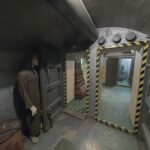
The first stop is the Pedestrian Tunnel Karlin-Zhizhkov, where you walk through a space that still carries Cold War thinking. The standout detail here is the locked doors leading to nuclear bomb-shelter corridors that were built during the Cold War and are still maintained.
This is not a museum lecture. It is a physical reminder that the era was built on contingency planning. When you see the corridor access blocked off, it gives weight to what you may have read about, the idea that safety was promised, controlled, and rationed.
The stop itself is quick, around 10 minutes, and it is free for the entry side of things. It also works as a mental warm-up. You start with security infrastructure before moving into monuments and protest culture.
Further routes we laced boots for
Vitkov Hill: the Red Army Hall, Gottwald’s mausoleum, and the pay-off views
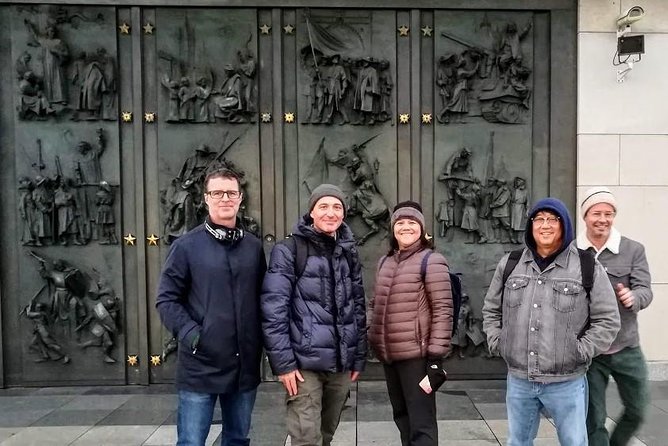
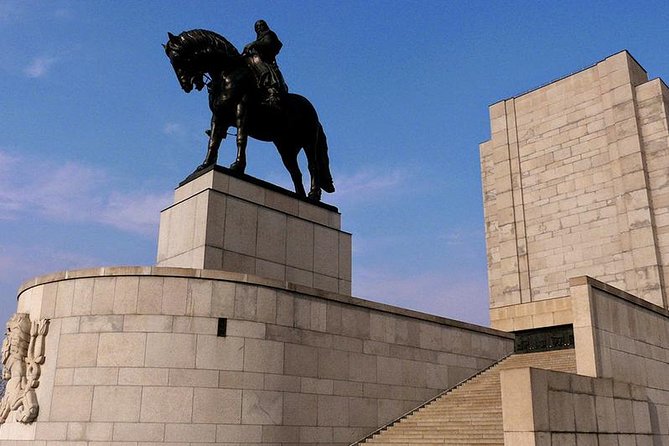
Vitkov Hill is the tour’s big climb, and it is the big reason you book this instead of doing a casual walk on your own. You head to the National Monument at Vitkov, where you find layered symbolism: Czech and Slovak World War I commemoration, Soviet honoring, and communist power made stone and ceremony.
Expect around 30 minutes for this stop. The admission is not included, so budget time and a bit of money for entering if you want to. Your guide will decide the timing with your pace, but the key point is this: you are going somewhere you cannot fully absorb just by looking from outside.
The Red Army Hall and Soviet memory politics
Inside this complex, you will see the Hall of the Red Army, designed to honor Soviet soldiers killed during World War II in Eastern Europe. On paper, that sounds like straightforward remembrance. In practice, it is also a message about who the system credits, and who gets narrative control.
Your guide’s job is to help you read the monument language: why it is placed where it is, how it is presented, and how it supported the Soviet-aligned version of history.
Klement Gottwald’s mausoleum, plus the eerie details
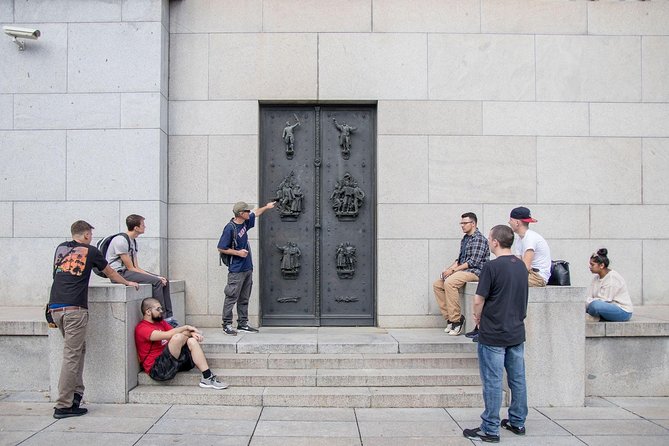
Another major moment is the former mausoleum of Klement Gottwald, the Communist Party leader and Czechoslovak president from 1948 to 1953. You will also peek into the laboratory and temperature-control center, where staff worked to maintain the embalmed body.
That detail hits harder than you might expect. It turns political mythology into something mechanical and managed, like preservation was the policy. You are not just hearing about cult-of-personality ideas; you are standing near the infrastructure that tried to keep them alive.
Jan Žižka monument and a city that spreads out
You will also see the Jan Žižka monument at Vitkov, including the fact it is the third largest bronze equestrian statue in the world. It is a reminder that this hill is not only Soviet-coded. It is also where Czech national symbols compete with imposed narratives.
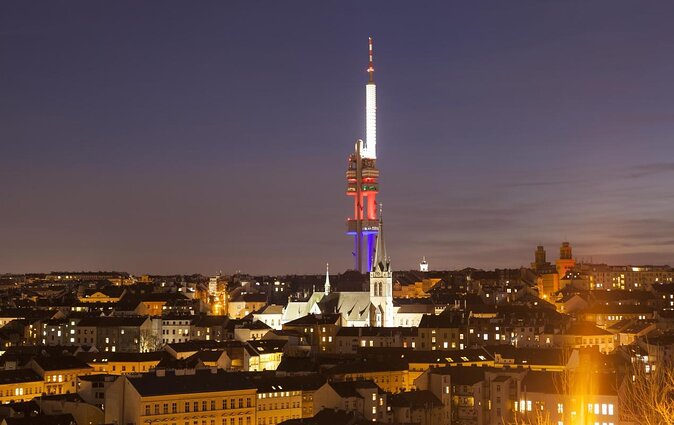
And then, the payoff: you climb the memorial and take in sweeping views over Old Town and beyond, including the Žižkov Television Tower on the horizon. If you take an afternoon departure, you might catch a sunset feel up here, which one guide described as stunning.
Prague TV tower (Žižkov): brutalism with a strong opinion
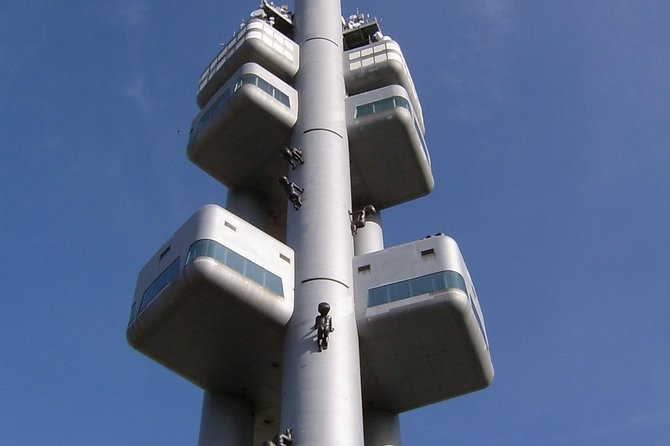
Next you make a quick stop at the Prague TV tower, the Žižkov Television Tower. You get a short visit, about 5 minutes, and the focus is the view and the architecture.
This tower is known for its Brutalist style, and it changes how you see Prague from the skyline. It is a different kind of power, less about ideology and more about what happens when a modern state tries to broadcast itself everywhere.
The entry for this stop is free. Even if you are not a architecture fanatic, the tower makes a useful contrast after Vitkov. It helps you compare Soviet-era monumental politics with later, more modern expressions of state presence.
Wenceslas Square: where 1968 was crushed, then 1989 exploded
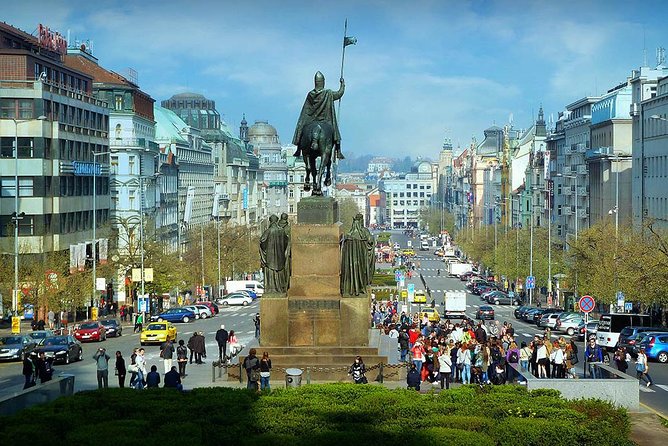
Now you shift back into the city center, and the tour turns outward to public space. Wenceslas Square is about 20 minutes, and it is the most “I can picture that” stop in the whole walk.
Your guide walks you through the square with its long arc: founded in the 14th century, then shaped by military parades from occupying powers, then marked by the Prague Spring era and its aftermath.
Here is what makes Wenceslas Square so important in this story:
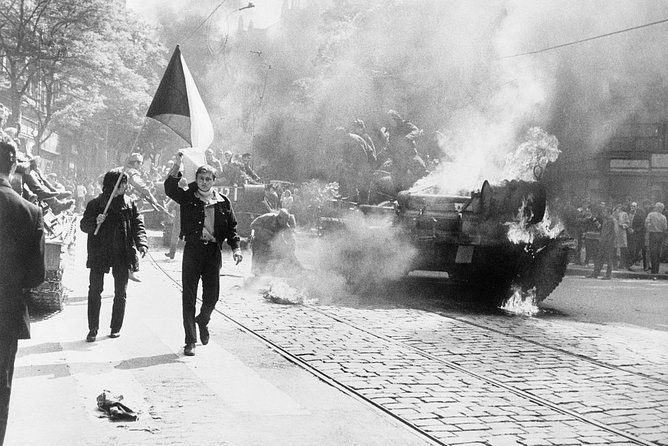
- In 1968, Warsaw Pact tanks converged here to crush the Prague Spring, which had allowed freedom of speech and an independent press for about eight months.
- In 1989, demonstrations and public pressure helped spark what people call the Velvet Revolution, ending communist rule.
You also look at monuments to protestors and hear how that bravery translated into momentum on the ground. This is where you understand that communism did not fall only because leaders changed. It fell because people showed up and kept showing up.
Lennon Wall: protest graffiti as a Cold War conversation
After Wenceslas Square, you stop at the John Lennon Wall, the wall where protest messages appeared through graffiti. In Cold War terms, it is an instantly readable symbol: people wanted Western-style freedom, so they wrote it where everyone could see.
Your guide places the wall in context. It is not just a photo stop. It is a snapshot of how normal people tried to push back through language, images, and hope when formal speech was controlled.
This is also a strong emotional pivot after the heavy symbolism of Vitkov Hill. You go from monuments built to project authority to a wall built to challenge it.
The upside-down King Wenceslas statue, and why Prague loves irony
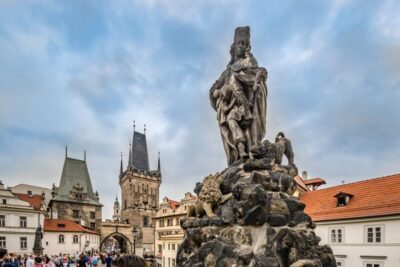
One quick but memorable stop is the Upside-Down Statue of King Wenceslas Riding a Dead Horse. It takes about 5 minutes, and it feels like a wink at Central European political mood.
The point is not the sculpture itself. It is what it signals, a kind of ongoing conversation about authority, failure, and how societies keep revisiting the same political questions in new clothing.
If you like history that does not treat every object as a solemn artifact, this stop is a nice release.
Tram tickets included, admission not included: how to budget the “real” cost
The tour price is $390.37 per group, for up to 10 people. That means the real value depends on how you are traveling.
- If your group is closer to 10, the effective cost can be roughly $39 per person.
- If it is just 2 people, it becomes about $195 per person.
- If it is only you, it is naturally the full group price.
So, treat this as a good deal when you are splitting the cost, or when you truly want a private guide for your own pace and questions. The private format matters here because Cold War history gets better when the guide can respond to you, not just speak at you.
Also plan for admission gaps. Some stops are free, including the tunnel stop and the TV tower stop. But the National Monument at Vitkov is not included. You are going to want to enter for the Red Army Hall and the mausoleum-related area, so factor that into the budget.
Food is not included either, so I recommend bringing water and keeping one small snack idea in mind. Your energy matters when the hill walk is on the schedule.
Who should book this Cold War Prague walking tour
This tour fits best if you:
- Want a private explanation of Soviet-era Prague rather than a generic highlights route
- Like guided context that connects politics to real spaces, not just dates
- Travel with a group that can realistically split the cost, or you want a guide you can question freely
- Enjoy protest history and symbolic street culture, like the Lennon Wall and Wenceslas Square
It also works well for educators or students in a classroom mode, because the guides highlighted an interactive style and a way of connecting concepts to what you see.
Mobility note: Vitkov Hill is the one thing to plan around
You should have moderate physical fitness. The tour includes a steep climb of about 20 minutes up Vitkov Hill. If mobility is a concern, there is an option to skip Vitkov Hill and focus on other Cold War-related sites.
That is worth taking seriously. If climbing is hard for you, ask early so you do not end up paying for time spent struggling instead of learning.
Should you book this tour?
If you want Prague history that feels lived-in, not just decorative, I think this tour is a strong choice. The mix of security infrastructure (the tunnel), political monuments (Vitkov and the Red Army Hall), and protest culture (Lennon Wall, Wenceslas Square) gives you a full Cold War arc in a compact 3-hour walk.
I would skip it only if you know Vitkov Hill climbing will be a deal-breaker, or if you hate paying additional admission on top of the tour price. If those are not issues, this private guided format gives you the kind of context that makes the city click fast.
FAQ
How long is the Private Prague Cold War Walking Tour?
It lasts about 3 hours.
Is this a private tour?
Yes. It is private, and your group is the only group participating.
What language is the tour offered in?
The tour is offered in English.
What is included in the price, and is admission covered?
The tour includes a historian guide and tram tickets. Admission is not included for the National Monument at Vitkov. Other stops listed, like the pedestrian tunnel and the TV tower, are free.
Do I need to arrange pickup, or is there a meeting point?
Hotel pickup is not included, but pickup is offered if you arrange it. Otherwise, you meet the guide about 15 minutes before at the default meeting point by Kostel Svaty Josef, Náměstí Republiky 1077/2.
Can I cancel for a full refund?
Yes, free cancellation is available. You can cancel up to 24 hours in advance for a full refund.
More Tours in Prague
More Tour Reviews in Prague
Between 1948 and 1989
Freshly written up in Prague
- World War II 4WD Tour from Prague with Lunch
★ 4.4 · 3 reviews - World War II History Tour of Prague’s Old Town
★ 5.0 · 3 reviews - Welcome to Prague – Private Tour with Licensed Guide
★ 5.0 · 3 reviews - Gourmet Brunch with Chef: Unlimited Drinks & Stunning River Views
★ 5.0 · 3 reviews - VIP Prague Segway Tour Around Monastic Breweries
★ 4.0 · 3 reviews
Communist Prague & Cold War History, compared.
 ★ 4.7Communism History and Nuclear Bunker Guided TourFrom $442,417 reviews
 ★ 5.0Prague Communism History and Nuclear Bunker TourFrom $451,742 reviews
 ★ 5.0Communism & Nuclear Bunker Tour + 70s Canteen Lunch (own expense)From $351,036 reviews
 ★ 4.8Communism and Bunker Tour with 70s Canteen LunchFrom $33250 reviews
 ★ 4.7World War II and Communist History TourFrom $34130 reviews
 ★ 4.93–Hour Communism and World War 2 E-Bike TourFrom $7456 reviews
 ★ 5.0Second World War & Communism (Tip-based 3 hour tour)From $347 reviews
 ★ 5.0Communism and World War 2 Prague City TourFrom $7833 reviews
Browse the lists this tour appears in